

AI
How to Identify AI Use Cases for Your Business
The best AI projects start with a well-understood problem, not a model. A practical framework for finding, scoring and validating AI opportunities.
By Vorynto Team · · 2 min read
Short answer: look for work that is frequent, language- or document-heavy, rules-of-thumb driven and currently done by people copying, reading, sorting or summarising information. Then score each idea by value, feasibility, data readiness and risk, and test the best one quickly on real examples.
Start with work, not with AI
Asking "where can we use AI?" tends to produce vague answers. A better question is: which tasks consume a lot of time, involve reading or writing, and follow patterns an experienced person could explain?
Good places to look:
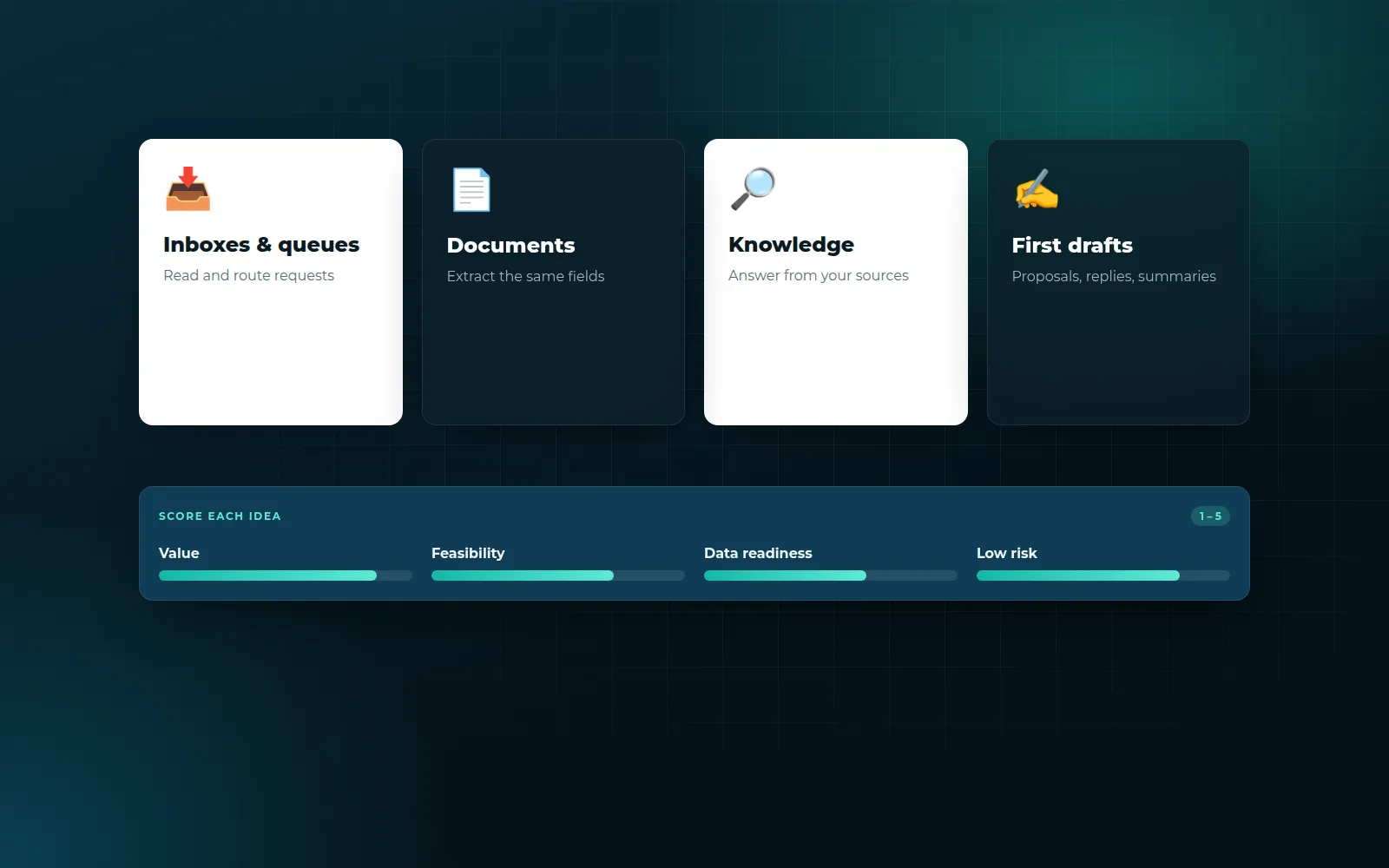
- Inboxes and queues — enquiries, support tickets, requests that need to be read and routed.
- Documents — invoices, contracts, applications or reports where people extract the same fields every time.
- Knowledge lookups — staff repeatedly searching policies, manuals or past projects for answers.
- First drafts — proposals, product descriptions, summaries and replies that follow a familiar structure.
- Classification — tagging, prioritising or categorising records.
Score each opportunity
Once you have a list, score each idea from 1 to 5 on four dimensions:
- Value — How much time, cost or customer experience improvement is at stake?
- Feasibility — Can current AI models do this reliably? Tasks involving reading, extracting, classifying and drafting usually score well; tasks requiring perfect factual precision without human review score lower.
- Data readiness — Do you have the documents, examples or system access needed?
- Risk — What happens if the AI gets it wrong? Low-risk tasks, or tasks with a human review step, are better first projects.
Prioritise ideas that score high on value and feasibility and low on risk.
Validate quickly
Before committing to a full build, run a small experiment:
- Collect 20–50 real examples of the task.
- Define what a "good" output looks like with the people who do the work today.
- Test a prototype against those examples and review the results together.
This reveals quickly whether the idea is viable, what the edge cases are and what guardrails are needed.
Design for humans in the loop
Most successful business AI tools assist rather than fully replace people at first. Showing sources, flagging low-confidence results and requiring approval for important actions builds trust and catches errors while the system proves itself.
Measure what matters
Decide upfront how you'll judge success: time saved per task, turnaround time, error rate, customer satisfaction or cost per request. Measure a baseline before launch so improvements are real, not assumed.
Common pitfalls
- Starting with the most ambitious idea instead of the most feasible one.
- Ignoring data privacy and access control until late in the project.
- Treating a promising demo as a finished product.
- Not involving the people who currently do the work.
If you'd like help working through this, Vorynto's AI analysis service follows exactly this approach, and our AI tool development and AI automation services take the best ideas into production.
- AI
- AI Analysis
- AI Automation