

SEO
What Makes a Website SEO Friendly?
An SEO-friendly website is fast, crawlable, clearly structured and genuinely useful. Here is what that means in practice — and what to ask for when you commission a new site.
By Vorynto Team · · 3 min read
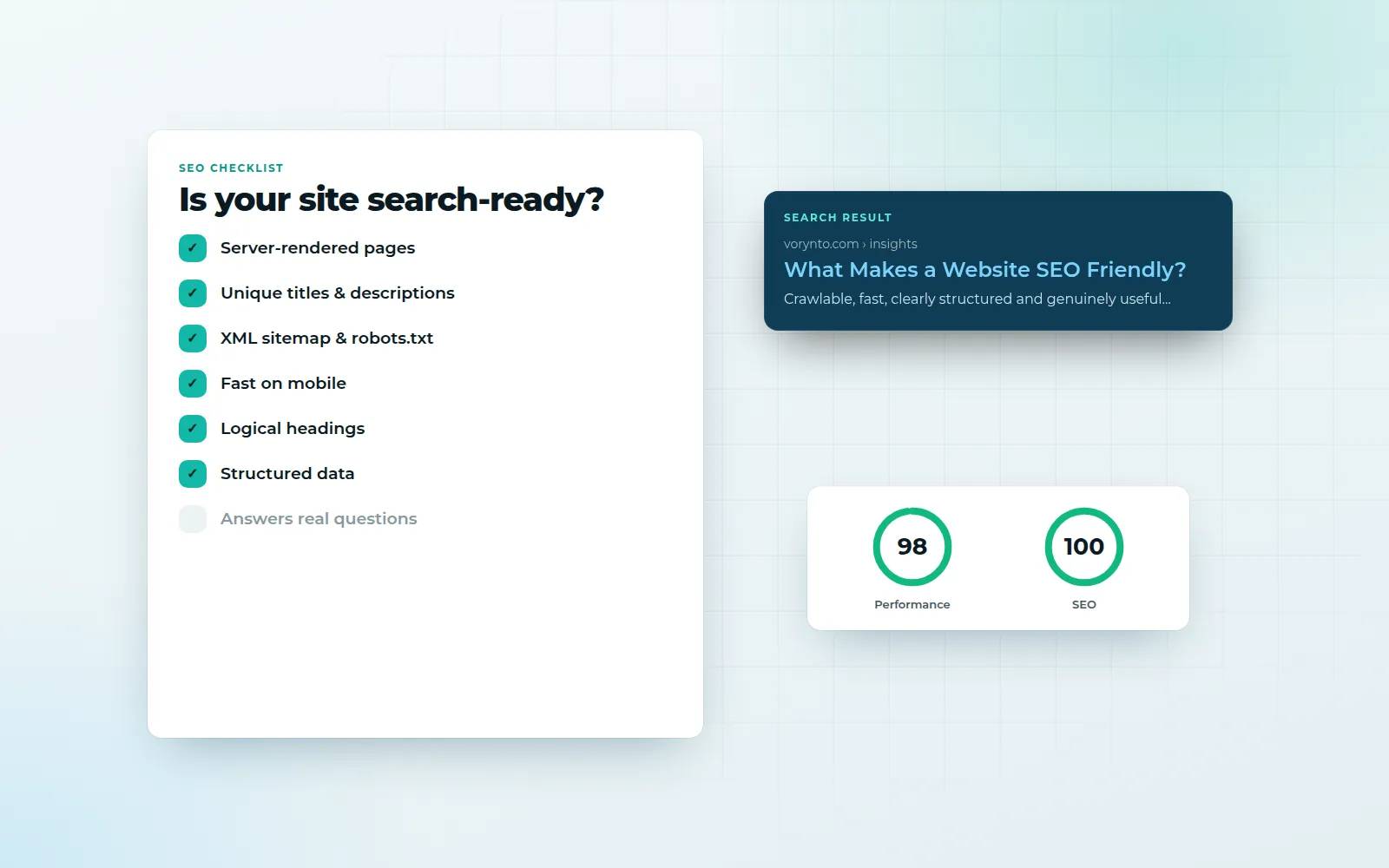
Short answer: an SEO-friendly website is one that search engines can easily crawl and understand, that loads quickly on real devices, and that answers the questions people are actually searching for. Technical quality gets you considered; useful content gets you chosen.
1. Search engines can crawl and index it
If search engines can't reach or read a page, nothing else matters. An SEO-friendly site:
- Serves meaningful HTML from the server, rather than relying entirely on JavaScript to render content.
- Has a clean XML sitemap and a sensible robots.txt file.
- Uses one canonical URL per page, so duplicates don't compete with each other.
- Returns correct status codes — 200 for live pages, 301 for moved pages and 404 for pages that no longer exist.
2. It is fast and stable
Page experience signals such as Core Web Vitals measure loading speed (LCP), responsiveness (INP) and visual stability (CLS). Good scores usually come from optimised and correctly sized images, limited third-party scripts, efficient fonts and code that only loads when needed.
3. The structure makes sense
Clear site architecture helps both people and search engines.
- One topic per page. Each important service or subject deserves its own focused page rather than a single page trying to rank for everything.
- Logical headings. One H1 that states what the page is about, followed by H2 and H3 headings that organise the content.
- Internal links. Related pages link to each other with descriptive anchor text, forming topic clusters.
- Breadcrumbs. They show where a page sits in the site and can appear in search results.
4. The metadata is intentional
Every page should have a unique title and meta description written for humans, plus Open Graph tags so links look right when shared. Titles that clearly describe the page usually perform better than titles stuffed with keywords.
5. Structured data describes the business
Structured data (JSON-LD using schema.org vocabulary) tells search engines exactly what they are looking at — an organisation, a service, an article, a set of FAQs. It must match the visible content; misleading markup can do more harm than good.
6. The content matches search intent
The most technically perfect page still won't rank if it doesn't satisfy the searcher. Before writing, ask: what is this person trying to do? Compare options, understand a concept, find a local provider, or get a price range? Then answer that directly, near the top of the page, and expand with detail below.
This question-first structure also helps AI-powered search experiences, which increasingly summarise and cite pages that give clear, factual answers.
7. It is accessible
Accessibility and SEO overlap more than people expect: descriptive alt text, semantic HTML, meaningful link text and readable contrast help screen readers and search engines alike.
A quick checklist for your next website
- Server-rendered pages with unique titles and descriptions
- XML sitemap, robots.txt and canonical URLs
- Fast loading on mobile, with optimised images
- One focused page per key service
- Logical heading hierarchy and internal linking
- Valid structured data that matches the page
- Content written to answer real questions
- Accessible markup and alt text
If you're planning a new website, it is far cheaper to build these qualities in from the start than to retrofit them later. That's why at Vorynto we plan web development and SEO together.
- SEO
- Web Development
- Technical SEO